A new NAHB special study found that buyers of newly built homes spend an average of $26,882 on appliances, furnishings, and property repairs in the first year after purchase — nearly three times what non-moving homeowners spend. Buyers of existing homes spend $18,673 in year one, and that repair spending carries into years two and three. This is the single biggest discretionary spending window most people will ever go through, and almost none of it involves a discount, a negotiated rate, or even a second quote.
The home-buying conversation stops at closing. Down payment, mortgage rate, closing costs — that's where the attention goes. What happens in the twelve months after is treated like an afterthought, if anyone talks about it at all.
A new special study from the National Association of Home Builders, published in August 2026 by economist Na Zhao, Ph.D., puts real numbers on that afterthought. And the numbers say this is not a minor expense category. It's the largest year of discretionary spending most homeowners will ever have.
The spending wave
NAHB used Consumer Expenditure Survey data from 2020–2023 to compare three groups: buyers of new homes, buyers of existing homes, and homeowners who didn't move. All three groups spend money on their homes every year. Only two of them spend like it's an emergency.
Buyers of newly built homes spend an average of $26,882 on appliances, furnishings, and property alterations and repairs in year one — nearly three times the $9,457 a non-moving homeowner spends annually.
Buyers of existing homes spend $18,673 in year one — roughly double the non-moving baseline.
The increase over baseline is almost identical for both groups — about $8,700 — but what they're spending it on is different.
Where the money actually goes
New construction buyers spend on furnishings and customization: $7,236 on furnishings alone in year one, plus a spike in appliances the builder didn't include — refrigerators, laundry units, lawn equipment. That spending mostly normalizes by year two.
Existing home buyers spend on repairs: $13,882 in year one, $5,498 more than a non-moving homeowner. And unlike new construction buyers, this doesn't taper off — existing home buyers keep spending meaningfully more on repairs in year two and year three, working through whatever the previous owner deferred.
NAHB's own explanation: existing homes "often required renovations, repairs, and deferred maintenance that are completed over time after purchase." Translation — the new owner inherits someone else's backlog and pays retail to work through it, one unplanned repair and one full-price appliance at a time.
The part nobody's optimizing
Here's what the NAHB study doesn't measure, because nobody's measuring it: how much of that $18,673–$26,882 gets spent at a price the homeowner didn't have to accept.
Not "did they shop at all." Most people compare something. The gap is narrower and more expensive than that — did they know which local pros actually discount for new movers, was there a negotiated rate on the appliance they had to replace in week three, did anyone tell them the water heater brand they were about to buy had a $150 rebate sitting unclaimed.
The homeowner replacing a dead water heater two weeks after closing isn't in a position to comparison-shop. They're in a position to say yes to whoever shows up. That's not a failure of effort — it's the predictable result of buying at the exact moment you have zero slack, zero local knowledge, and a problem that can't wait.
Multiply that moment by every appliance, every contractor, and every "while we're here" repair in year one, and the $18,673–$26,882 stops looking like a spending number and starts looking like a savings opportunity nobody's collecting on.
Why this outlasts year one
The data on existing home buyers is the important part: repair spending stays elevated in years two and three. This isn't a one-time move-in cost. It's a multi-year catch-up on a home whose condition and history the new owner never had visibility into.
Every year of that catch-up is another round of full-price repairs and unshopped contractor bids — unless the homeowner has something in place before the next unplanned expense hits, not after.
What this means for the first 30 days
The NAHB numbers explain exactly why the first 30 days after closing matter more than any other window in homeownership: this is when spending is heaviest, decisions are most rushed, and the homeowner has the least context for what a fair price even looks like.
It's also, not coincidentally, exactly when "just moved and already need a new oven?" stops being a hypothetical and starts being Tuesday.
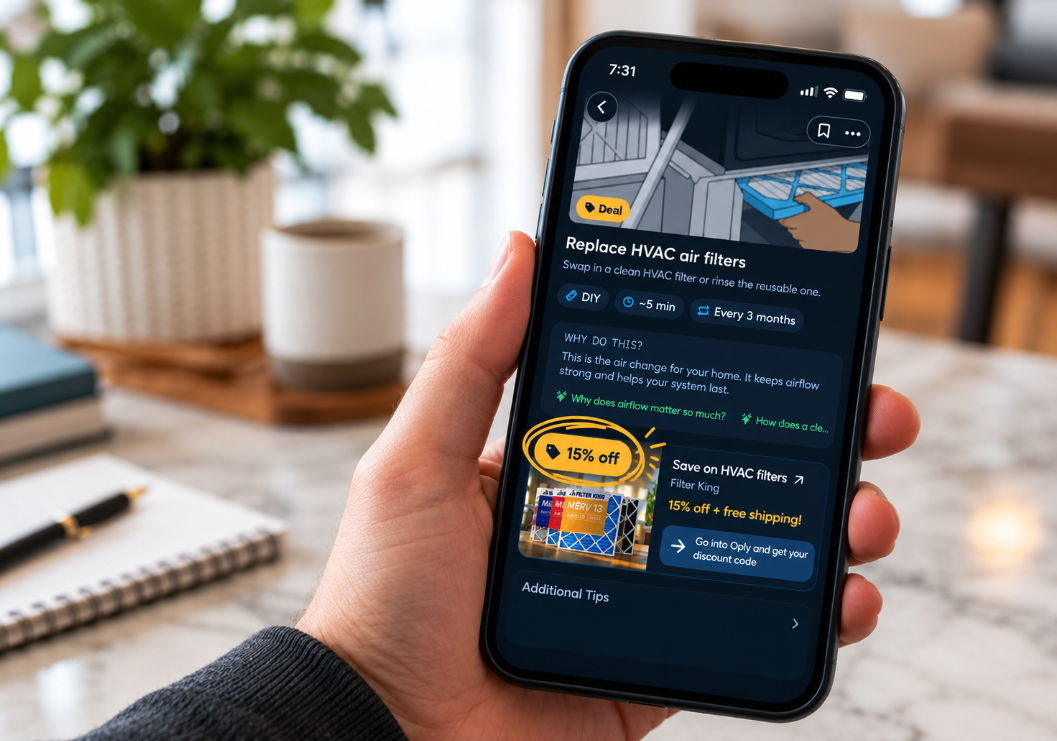
Oply exists for this window. It's an app that matches homeowners to real, verified discounts — on the appliances they're about to buy anyway, on the local pros they're about to hire anyway — and shows the savings before asking for anything. You only pay to unlock a specific deal, and only when the savings clearly outweigh the fee.
The bottom line
New homeowners spend $18,673 to $26,882 in year one. Existing home buyers keep spending well above baseline on repairs for years after that. NAHB measured the spending. Nobody's measured how much of it was avoidable — but the pattern is obvious: the moment you have the least time and context to shop around is the moment you're spending the most.
That's the gap Oply is built to close. We're building a membership that matches new homeowners to real, verified discounts on the exact things this data shows you're about to buy — appliances, repairs, local pros — before you overpay for them. Early access opens in the coming months.